
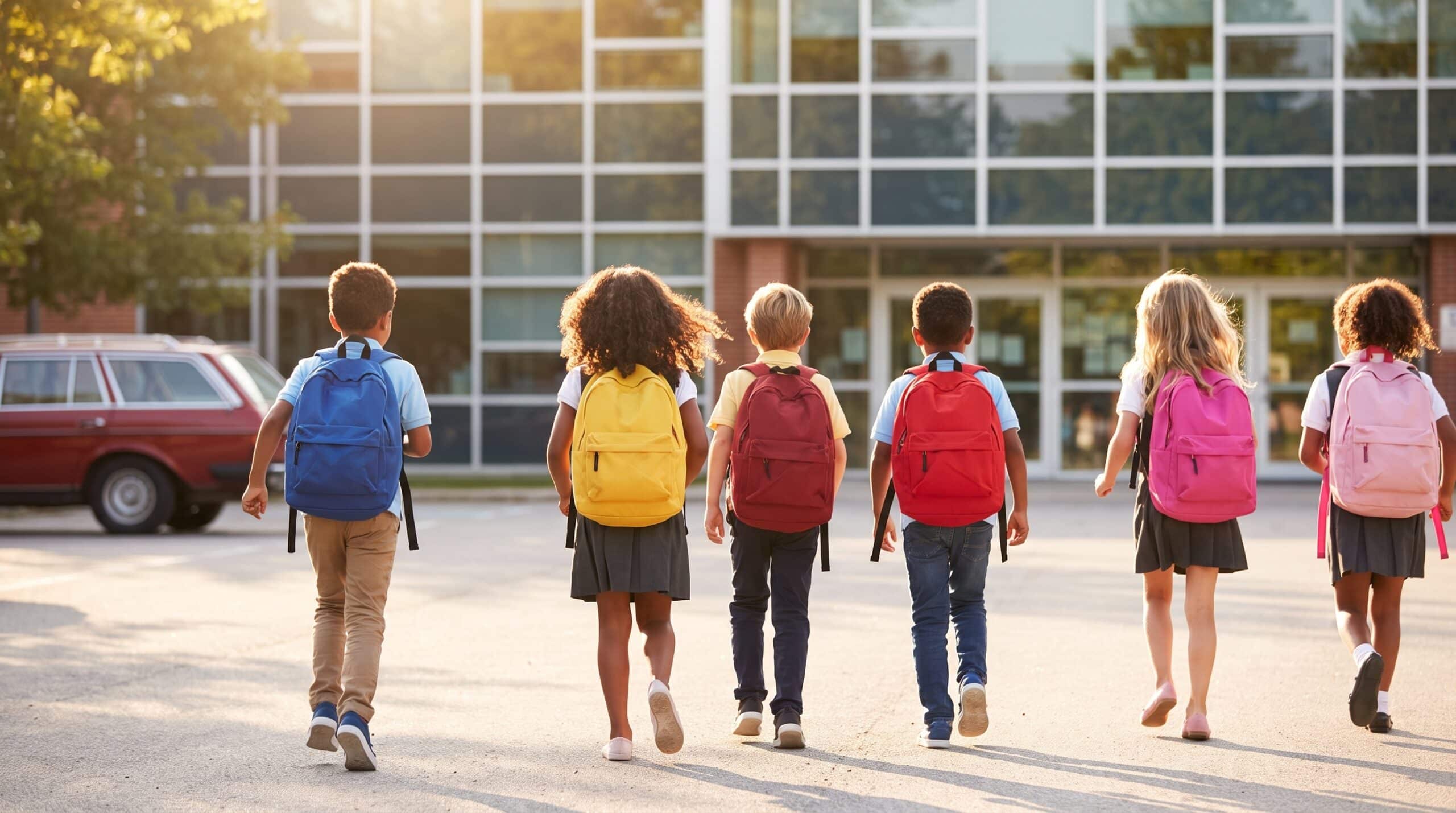
Belgium is unique in the large range of educational pathways it offers. Families living in the Brussels-Capital Region may freely choose to send their children to French-medium or Dutch-medium schools or a European or international school. Under certain conditions, children may also be homeschooled.
This article by the Expat Welcome Desk tells you what you need to know in order to choose the right educational pathway for your child.
Context
In Belgium, the right to education is a fundamental right. Freedom of education is guaranteed and devolved to the language communities[1].
Compulsory education applies from ages 5 to 18
and places a dual obligation on parents:
Children begin school in primary education (preschool and primary school). This is followed by secondary school (organised according to cycles and levels), which is split into a ‘general’ track (also known as ‘transition’, leading into higher education) and a ‘professional’ track (known as ‘qualification’, leading directly into the job market).
The Belgian school system is decentralised. Education is funded and run by each language community (Flemish, French and German-speaking). Schools are split into ‘networks’, with the exception of private schools that do not receive state subsidies. There are two networks: official education and free education.
A school in the official network can either be run directly by the language community or by the provincial or municipal authority. A school in the free network may be denominational or non-denominational.
Community education: run by the three language communities (Flemish, French and German-speaking) and equivalent to state education in other countries. Schools respect the religious, philosophical and ideological beliefs of parents and children in a neutral system.
The Belgian education system is divided into four levels:
Preschool – ages 2.5 to 6
Preschool begins at the age of 2.5 (or 3) and lasts three years. Although attendance is not compulsory in the first two years, your child must be enrolled from the third year of preschool (age 5). The system is designed to prepare young children for primary school rather than as a form of child care.
Primary school – ages 6 to 12
Primary education is compulsory and free. It consists of a six-year cycle from the ages of 6 to 12. Children may attend primary school starting from 1 September of the calendar year in which they turn six. Schooling at this level prioritises reading, writing and basic maths. A second official language – French or Dutch – is taught as a compulsory subject from the third year.
Secondary school – ages 12 to 18
Secondary education is also compulsory and free. There are various types of educational pathways, the four main ones being:
Higher education – ages 18+
Higher education is not compulsory. It is open to students who have successfully completed general or technical secondary education. Colleges and universities in Belgium offer a wide range of programmes.
French-medium education is run by the French Community of Belgium (Fédération Wallonie-Bruxelles, FWB).
Enrolling your child in the FWB network
Preschools and primary education follow the same enrolment process. For secondary education, please follow the enrolment instructions given on the FWB’s website
If your child is struggling to find a secondary school place, the Zonal Enrolment Committee (Commission Zonale des Inscriptions, CZI) can provide support:
Homeschooling in the FWB:
While homeschooling is permitted, it must align with your child’s right to education and the requirement for compulsory education.
Parents who homeschool their children must complete a series of procedures each year and comply with the general conditions of eligibility that apply to all children. These are that:
Additional conditions apply once your child turns 12: these conditions are linked to the child’s age and previously completed schooling. Please be aware that exceptions to the rule may be granted on a case-by-case basis (e.g. if your child has a disability or mental health problem).
If you wish to homeschool your child, you must submit a homeschooling request each year. This request may be submitted from 1 July preceding the school year in which you intend to homeschool your child and at the latest by 5 September of that year. Bear in mind that this request is compulsory and must be made each year, within the aforementioned timeframe, using the ‘homeschooling declaration form’ – see below.
Further info
Homeschooling service (Service de l'enseignement à domicile, EAD)
Dutch-medium education is run by the Flemish community.
Dutch-medium education: how to enrol your child
To enrol your child at a Dutch-medium school in Brussels, you must complete an advance enrolment online by a certain date.
All information on enrolment and advance enrolment for Dutch-medium preschool, primary and secondary education and special needs Dutch-medium education in Brussels can be found on Inschrijven in Brussel (in Dutch only).
If you are struggling to enrol your child, please contact the local consultation platform.
Homeschooling in the Flemish community
If you wish to homeschool your child, you must submit a homeschooling request (in Dutch) and additional information regarding homeschooling to the Agency for Educational Services (Agentschap voor Onderwijsdiensten, AGODI). This request must be submitted at the latest by the third day of classes in the school year in question. Please be aware that you must submit a declaration on an annual basis for each school year in which you intend to homeschool your child.
Most municipalities in Brussels have French-medium and Dutch-medium schools.
Brussels’ European schools provide continuous schooling from preschool age to 18 in all European languages.
Priority for admission is given to children of civil servants working at international institutions and children of diplomatic personnel.
International schools
These are private institutions offering bilingual teaching (usually in English or French) at preschool, primary or secondary level or a combination thereof.
Home to over 25 institutions, Brussels has a broad range of international schools to serve its lively expat community. Whether you are looking for a country-specific educational programme, internationally recognised qualifications or an alternative educational approach, you are very likely to find an option that suits your child. However, please be aware that tuition fees can be high.
Homeschooling in European and international schools
Children enrolled at a European or international school fall within a distinct education system that is not part of the Belgian school system.
For more information, we recommend you contact the secretary’s office of the European or international school you are interested in. They will be able to tell you which steps you need to take in your situation.
[1] Article 24 of the Belgian constitution; Article 7 of the UN Declaration of the Rights of the Child of 20 November 1959, Article 28 of the UN Convention on the Rights of the Child of 20 November 1989.
past events